

You’ve got a fresh dent in the door of your BMW. Shopping trolley at Chatswood Westfield, a neighbour’s bin that blew over, or an absent-minded driver reversing next to you at Lane Cove. The paint is fine. The metal is pushed in. You’re sitting at your desk weighing up whether to get it repaired properly, live with it, or ask around about this paintless dent thing people keep mentioning.
At North Shore Smash Repairs in Artarmon, paintless dent repair (PDR) is a core part of what we do, and a particular specialty on prestige cars where protecting the factory finish matters. In the right situation, PDR is cheaper, quicker, and leaves the car closer to original than any other method. In the wrong situation, it’s not an option at all and the honest answer is traditional repair. This article walks through the difference.
What paintless dent repair actually is
Paintless dent repair is a panel repair method that reshapes the metal of a dented panel without touching the paint. A skilled technician works from behind the panel using specialised rods and tabs, pressing and massaging the metal back to its original shape. No filler, no sanding, no respray. The factory paint stays exactly as it was.
Access from behind the panel is the usual approach. On a door skin, that means removing the trim card and working through openings in the inner structure. On a bonnet, it means going in past the underside reinforcement. Where rear access isn’t possible (a roof section with a glued headliner, some closed structural panels), technicians use a glue-pull technique instead. Small plastic tabs are glued to the outside of the dent, pulled outwards with a slide hammer or bridge, then released with heat or alcohol once the metal is out.
The job takes anywhere from 30 minutes for a single small dent to a full day or more for multi-panel hail. The test of quality work is simple: the panel looks untouched afterwards. No ripple in the reflection, no tool marks, no paint work.
When paintless dent repair works well
Three conditions have to line up. Paint has to be intact, the panel has to be accessible from behind or by glue-pull, and the dent has to be within the size and depth a technician can work with.
- Paint condition is the single most important factor. If the paint is cracked, chipped, scored, or crazed anywhere across the dent, PDR is off the table. The method relies on the paint flexing back into shape as the metal underneath is repositioned. Any break in the clear coat or base coat means the paint can’t follow the metal, and the result looks worse, not better.
- Panel access covers most common dent locations. Doors, bonnets, front guards, rear quarters, boot lids, and tailgates all have some way in. Roof panels are harder because of the headliner. Some closed structural areas can’t be reached at all.
- Dent type. The industry shorthand for a classic PDR candidate is a coin-sized dent with no sharp edge. Australian technicians often describe size using coins – a 5-cent piece, a 10-cent, a 20-cent, a 50-cent. Most dents in that range are comfortable PDR work. Larger dents, including football-sized shallow ones, can still be PDR candidates if the paint is intact and the metal hasn’t stretched. Depth and sharpness matter more than raw size. A wide, shallow dent is easier to work than a small, deep one with a sharp crease.
Typical PDR candidates include shopping trolley dents, minor hail, low-speed parking dings, door-ding contact from the car next to you, and falling branches on bonnets and roofs.
When paintless dent repair isn’t the right call
PDR has real limits and a good technician will tell you upfront when a dent isn’t suitable. Forcing the method on the wrong damage produces a compromised result and costs money that should have gone into doing the job properly.
- Paint damage. Any crack, chip, score, or star in the paint means the panel needs conventional repair. That usually involves panel beating, filler where required, and a respray of the affected panel.
- Sharp creases with stretched metal. Deep, sharp creases where the metal has been stretched generally can’t be worked out cleanly with PDR alone. A skilled technician can often improve them, but the finish usually still needs conventional work afterwards.
- Dents on body lines and panel edges. The sharp styling crease running along a door or bonnet, and the edges of panels, are the hardest places to work from behind. The metal is reinforced and the tool access is limited. Some are workable with glue-pull; many end up as conventional repair.
- Dents where filler has been applied previously. If the panel has had body filler from an earlier repair, PDR can’t work on that area. The filler is rigid and doesn’t flex the way factory metal does.
- Collision damage. Anything beyond a minor impact – crumpled panels, bent structure, cracked paint, broken plastic – is a conventional smash repair. PDR isn’t designed for and shouldn’t be used on collision damage.
In all of these cases, the right answer is traditional panel repair followed by a matched respray. It costs more and takes longer, but the panel ends up looking factory when it’s done properly.
Paintless dent repair on prestige vehicles
Prestige vehicles – BMW, Audi, Mercedes-Benz, Porsche, Jaguar, Land Rover, Maserati, Aston Martin – change the technical picture in two important ways.
Thinner factory paint. Factory paint on modern cars typically sits between 100 and 180 microns in total (that’s the whole system: primer, base coat, clear coat). Several European prestige brands run at the thinner end of that range. BMW’s factory paint averages around 120 microns in published data, and individual panels can measure lower. Thinner paint is less forgiving of any over-stretch during PDR work. A technique that’s safe on a 160-micron mainstream panel can leave faint waves on a 110-micron prestige panel. The work takes longer, the tool selection is different, and finish inspection has to be more exacting.
Aluminium construction. Late-model BMW, Audi, Jaguar, Range Rover, and others use aluminium for the bonnet, doors, boot lid, and sometimes the roof. Aluminium behaves differently to steel under PDR. It doesn’t spring back the same way, the grain is less forgiving, and wrong technique can leave the panel slightly wavy in ways steel wouldn’t. It also has narrower heat limits, which rules out some standard approaches and rules in specialist tooling and heat-induction equipment. It’s a specialist technique within an already specialist trade.
Tighter factory panel gaps. Prestige cars are built to tighter panel tolerances than most mainstream vehicles. Panel gaps are narrower, lines are sharper, and the eye is trained to notice any deviation. A PDR finish on a Porsche or an Aston Martin has to hold up under the same scrutiny as the factory build. That means multiple lighting setups during inspection and longer per-dent work times.
This is the layer of the job that generic PDR information online doesn’t cover. Working on a Porsche boot lid is not the same job as working on a HiLux door, and the shop doing it has to be equipped for the difference.
PDR at a glance: what’s likely, and what it costs
| Dent or damage type | Likely repair method | Typical cost range |
|---|---|---|
| Single small dent, paint intact (shopping trolley, door ding) | PDR | $150–$300 |
| Multiple small dents, same panel (car park, minor hail) | PDR | $300–$900 |
| Minor hail across several panels | PDR | $500–$1,500+ |
| Dent with cracked or chipped paint | Conventional repair and respray | $400–$1,200+ |
| Dent on a body line or panel edge | PDR if accessible, otherwise conventional | $200–$900+ |
| Dent where filler has been applied previously | Conventional repair and respray | $400–$1,200+ |
| Sharp, deep crease with metal stretch | Conventional repair and respray | $500–$1,500+ |
| Collision damage (bent structure, crumpled panel) | Full panel repair or replacement | Assessment required |
| Dent on prestige aluminium panel, paint intact | Specialist PDR | Higher end of PDR range |
What paintless dent removal costs in Sydney
Cost comes down to four things: the number of dents, the size and depth of each, the panel they’re on, and the vehicle. Here’s what the ranges look like across Sydney workshops at the time of writing.
- A single small dent, paint intact: $150 to $300. Entry-level PDR in Sydney starts around $160 including GST for a simple dent on an easy-access panel. That’s the floor, not the typical figure. Most single-dent jobs sit closer to $250, and prestige work on thinner paint or aluminium panels runs higher again.
- Multiple dents on the same panel: $300 to $900. Per-dent cost drops as the count goes up because setup and access time is spent on the first dent. A dozen small dimples on a single bonnet is usually cheaper than two dents on two different panels. The upper end of the range covers heavier dent clusters and prestige panels.
- Minor multi-panel hail damage: $500 to $1,500 and up. Once hail has hit the whole car, the quote depends on the dent count per panel and the total panel count. A single storm with pea-sized hail across roof, bonnet, and boot typically sits in this range for minor damage. Complex prestige hail work regularly exceeds it.
- Severe or heavily damaged single panels: up to $3,000 or more. Where dent counts run into three figures, or where some dents have cracked the paint, the job becomes mixed. Some panels go through PDR, others go through conventional repair, and the final cost comes out of a full panel-by-panel assessment.
Prestige vehicles generally sit at the higher end of any given range. The thinner paint, aluminium panels, and longer per-dent work times all contribute. That’s not a mark-up for the badge. It’s genuine additional time on the tools.
How to tell if a shop does paintless dent repair properly
Four things separate quality PDR work from rushed versions that show up in pop-up storm-chaser operations.
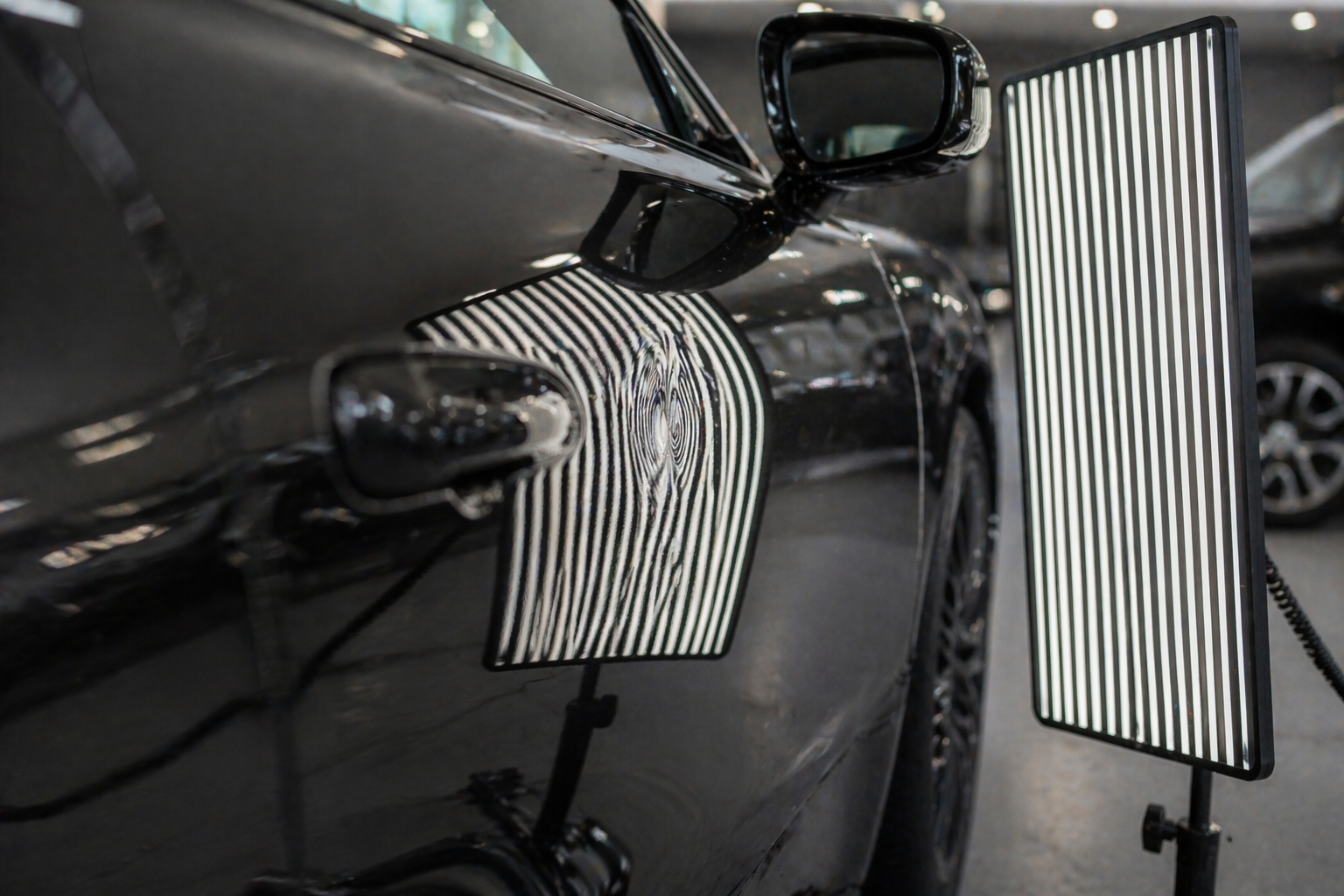
Proper lighting. PDR boards (flat-panel LED or fluorescent boards with a gridded face) or LED line lights are the standard equipment. A technician works with one of these positioned so that any high or low spot in the panel distorts the grid lines in the reflection. Without that setup, it’s not possible to see the fine detail of how a dent is responding. A shop doing PDR without PDR boards is doing a rough version of the job.
Technician experience over tool count. PDR is a hand-tool trade and experience matters more than the tool stack. Francois Jouy, widely credited with introducing the technique to Australia in 1985, works with around 100 tools, most of them hand-made and refined over decades. The skill is in knowing which tool to use where, and how much pressure to apply. Ask how long the technician has been doing PDR specifically (not general panel beating) and whether they work on prestige cars regularly.
Finish inspection in natural light. PDR work should always be checked in daylight as well as under shop lighting, and at multiple viewing angles. A dent that looks perfect under one light can show up faintly under another. If the shop hands the car back without walking you around it outside, that’s a sign.
No filler on a PDR job. True PDR uses no body filler. If the quote mentions filler, it’s not a PDR job. It’s a conventional repair. Clarify that before any work starts.
Back to the shopping trolley dent on the BMW door. If the paint is intact, PDR is the first option to ask about. It’s cheaper, it’s faster, and on a prestige car it keeps the original factory finish on the panel, which matters for resale and for the way the car reads down the track. If the paint is cracked or chipped, or the dent sits on a sharp body line, it’s a conventional repair instead, and any honest panel shop will tell you that before quoting.
At North Shore Smash Repairs, we assess every dent in person before committing to a method. Send us a photo or bring the car into our Artarmon workshop, and we’ll tell you straight whether PDR is the right call.
Frequently asked questions
Yes, as long as the paint is intact across the affected panels. Minor hail with pea-sized to 20-cent-sized dents is typical PDR work. Larger hail that has cracked the paint or creased the metal sharply needs conventional repair instead. After a major storm, insurance assessments usually identify which panels are PDR candidates and which aren’t before repairs begin.
A single small dent takes 30 minutes to an hour once the panel is accessible. Multiple dents on one panel can be done in a half-day. Full hail damage across a car usually takes one to three days depending on dent count. Complex prestige work takes longer because the per-dent time is higher.
Most comprehensive policies cover PDR the same way they cover conventional panel repair, provided the damage was caused by a covered event (storm, collision, vandalism, falling objects). The claim process is the same. On a hail claim, your insurer’s assessor identifies PDR-suitable panels as part of the quote. You can usually nominate your own repairer under the choice of repairer terms in your policy – check your Product Disclosure Statement for the exact wording.
When it’s done properly, no. The method is specifically designed to leave the paint untouched, and modern automotive paint is flexible enough to reshape with the metal underneath. Damage tends to happen when PDR is attempted on paint that was already compromised (a hairline crack or chip missed at quoting stage), or when untrained hands push the metal too far too fast.
Sometimes. A dent sitting fully to one side of a body line, or a shallow dent crossing a soft line, is usually workable. A sharp crease right along a body line is much harder, and in many cases a conventional repair delivers a better finish. The honest answer has to be case-by-case. Send a photo or bring the car in before committing either way.




