

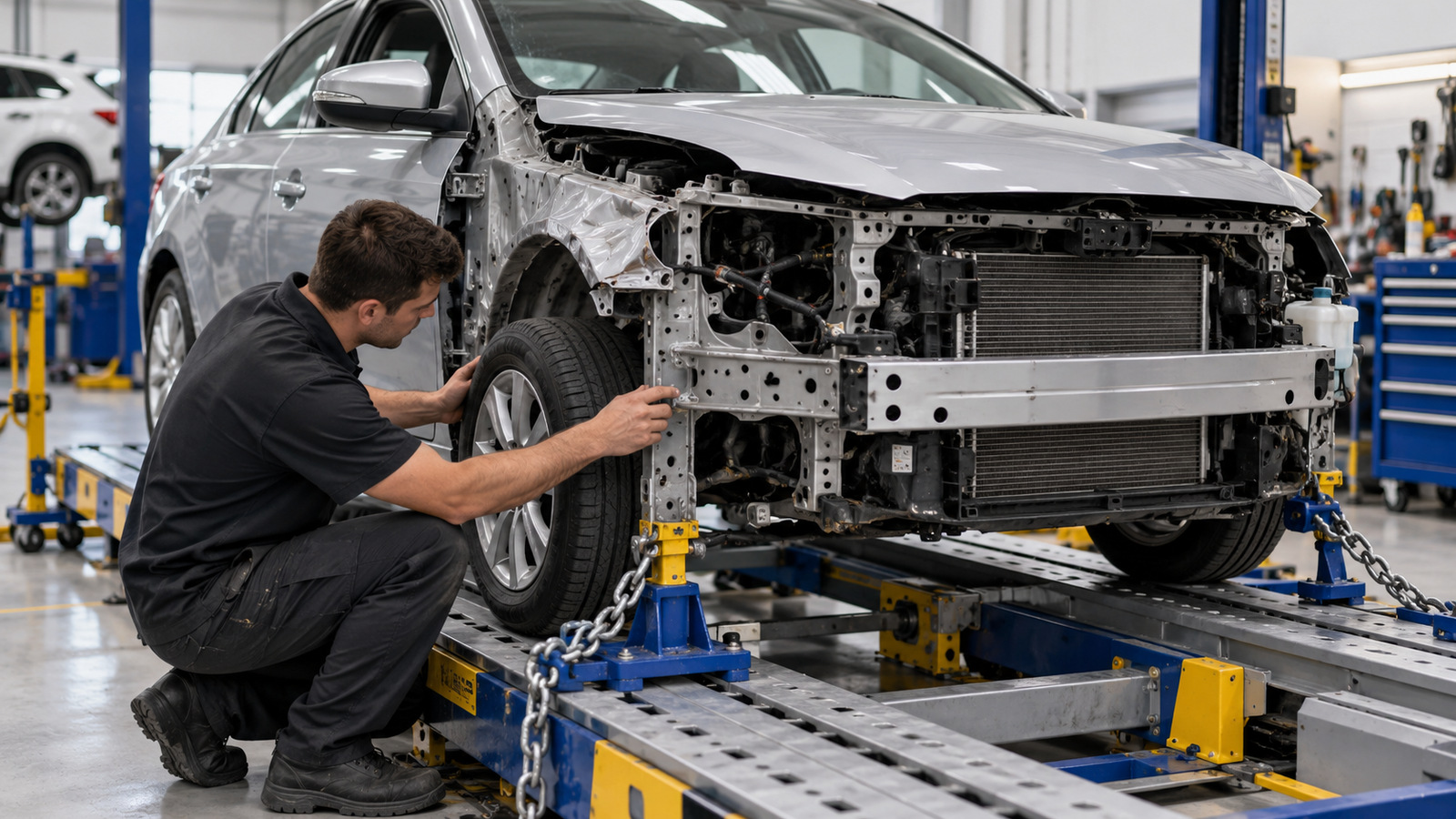
A bent chassis can often be repaired. Most cars built today have no separate chassis at all. What gets straightened is the welded body shell itself. It is anchored on a measuring bench, pulled back towards the dimensions the carmaker published for that model, then measured again. What settles the answer is whether those measurements come back inside the carmaker’s allowance, not how bad the car looks.
If an assessor has told you the structure has moved, that is a finding with a number behind it, not a verdict.
If the crash has only just happened, read what to do in the first 24 hours after a crash, then come back to this.
What is a chassis on a modern car?
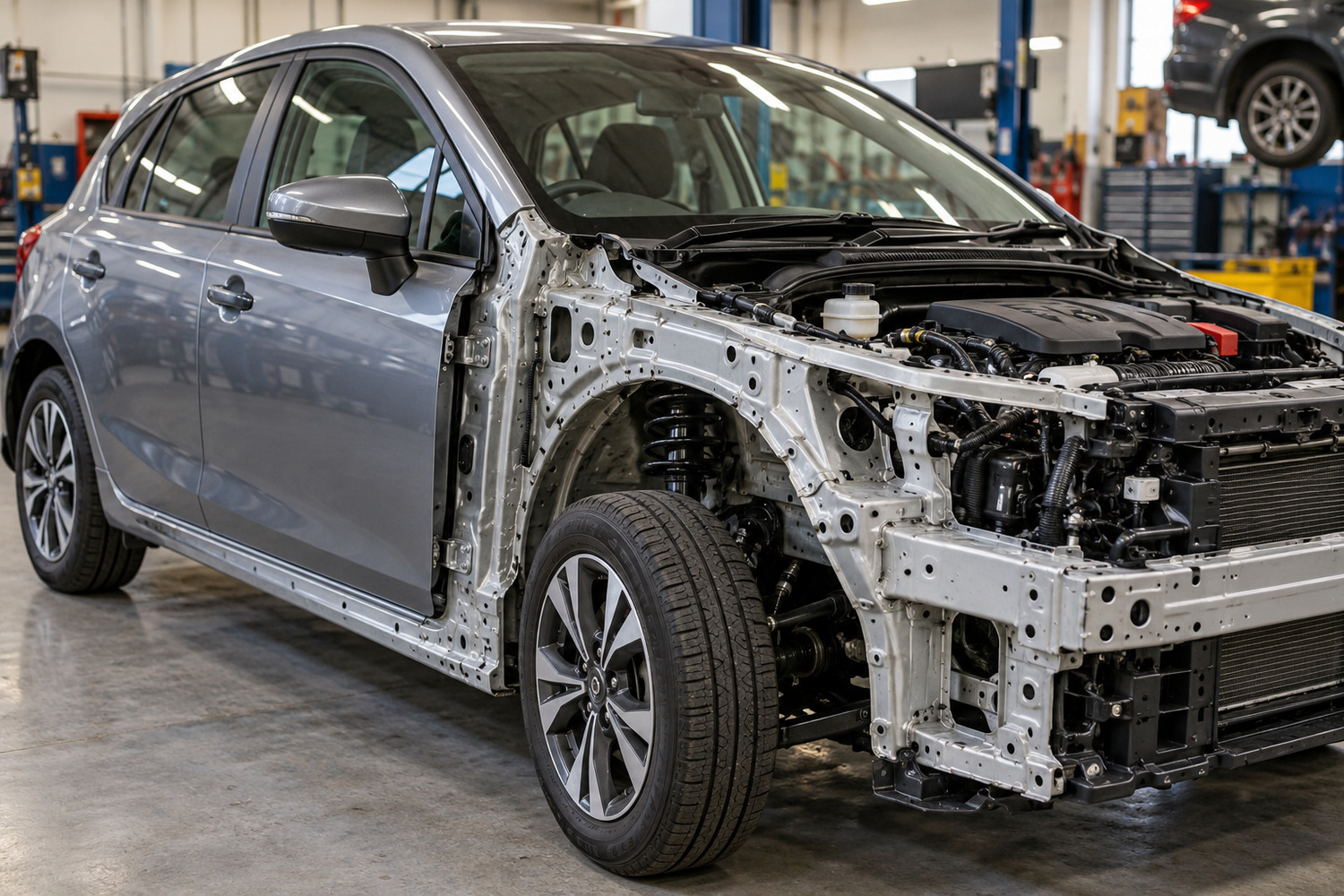
A chassis is the structure a car is built around. It holds the suspension, the engine and the cabin in place, and carries the loads of driving and of a crash. On most cars built today it is not a separate part. The body and the structure are one welded shell. That is called unitary or monocoque construction: the panels and the shell carry the loads together. There is no frame underneath to bolt a body onto.
People still say chassis, and they are right to. On a car built this way the word means the underbody. That is the rails, the floor, the mounting points, and the pillars behind the panels you can see. It is the part an assessor means when they say the chassis is bent.
Utes are mostly built the other way, on a separate ladder frame, as are some four-wheel drives. Straightening one of those is a different job.
How is chassis damage found?
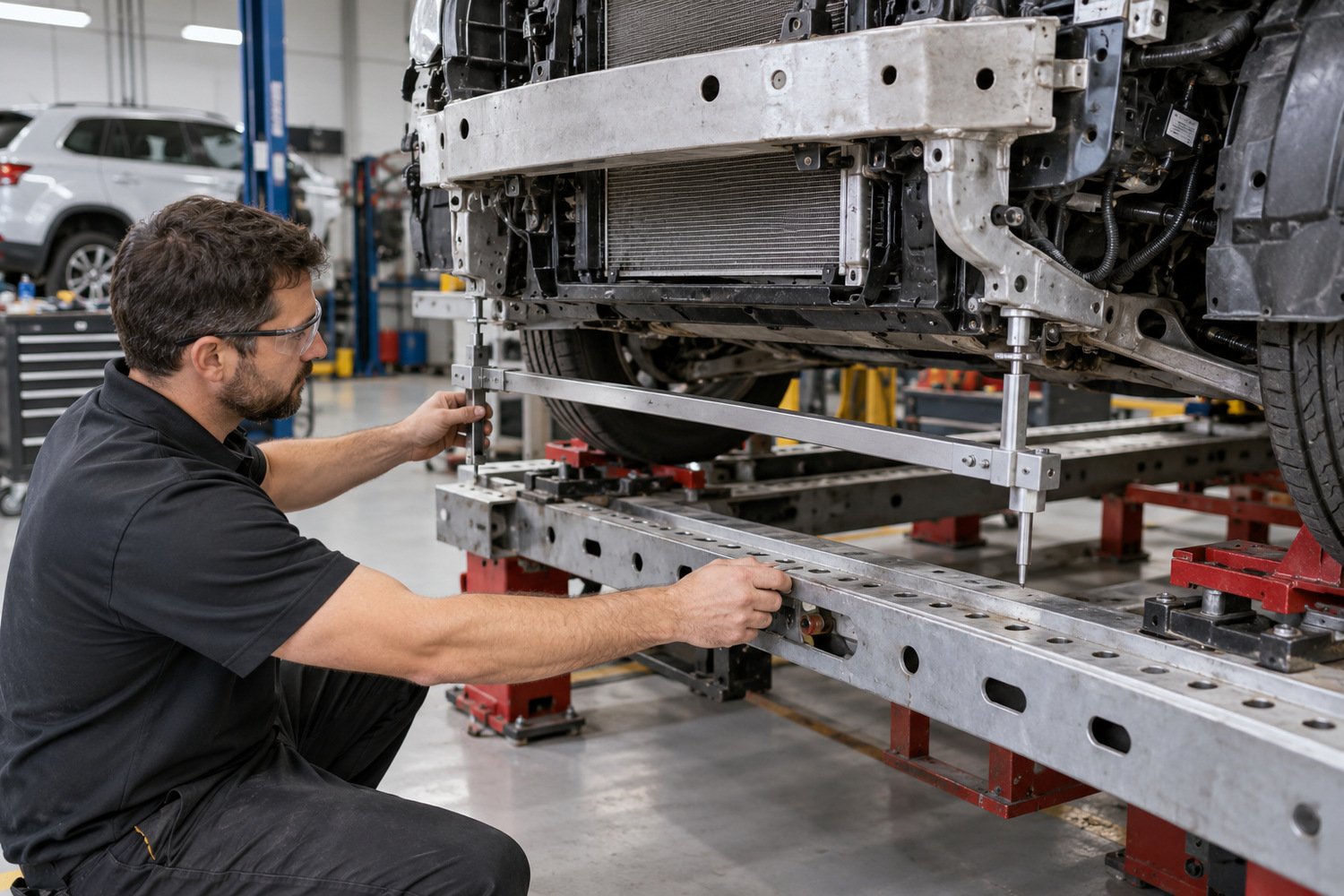
Chassis damage is measured, not eyeballed. The car is anchored down on a measuring bench or a jig. Electronic or laser measuring equipment reads fixed reference points on the underbody. It compares them with the figures the carmaker published for that model, and the difference comes back as a number. Measuring those points, and correcting them, is called chassis alignment.
Two things follow, and they are rarely explained to an owner. A car can look straight and still measure wrong. A car can look dreadful and measure within tolerance, which is the allowance the carmaker sets for how far a point may sit from its published spot. Appearance is not the test.
The second is whose figures they are. The reference data belongs to the carmaker, not to the workshop. That is what makes it a finding rather than an opinion.
A shell can also be out of square across the car rather than bent along it. The diagonals can be wrong while the lengths down each side read correctly. So a car can measure right in one direction and still be wrong.
Structure does not announce itself either. Some of it shows only once trims, guards, and lamps come off. That is one reason smash repair quotes vary so much.
Can a bent chassis be straightened?
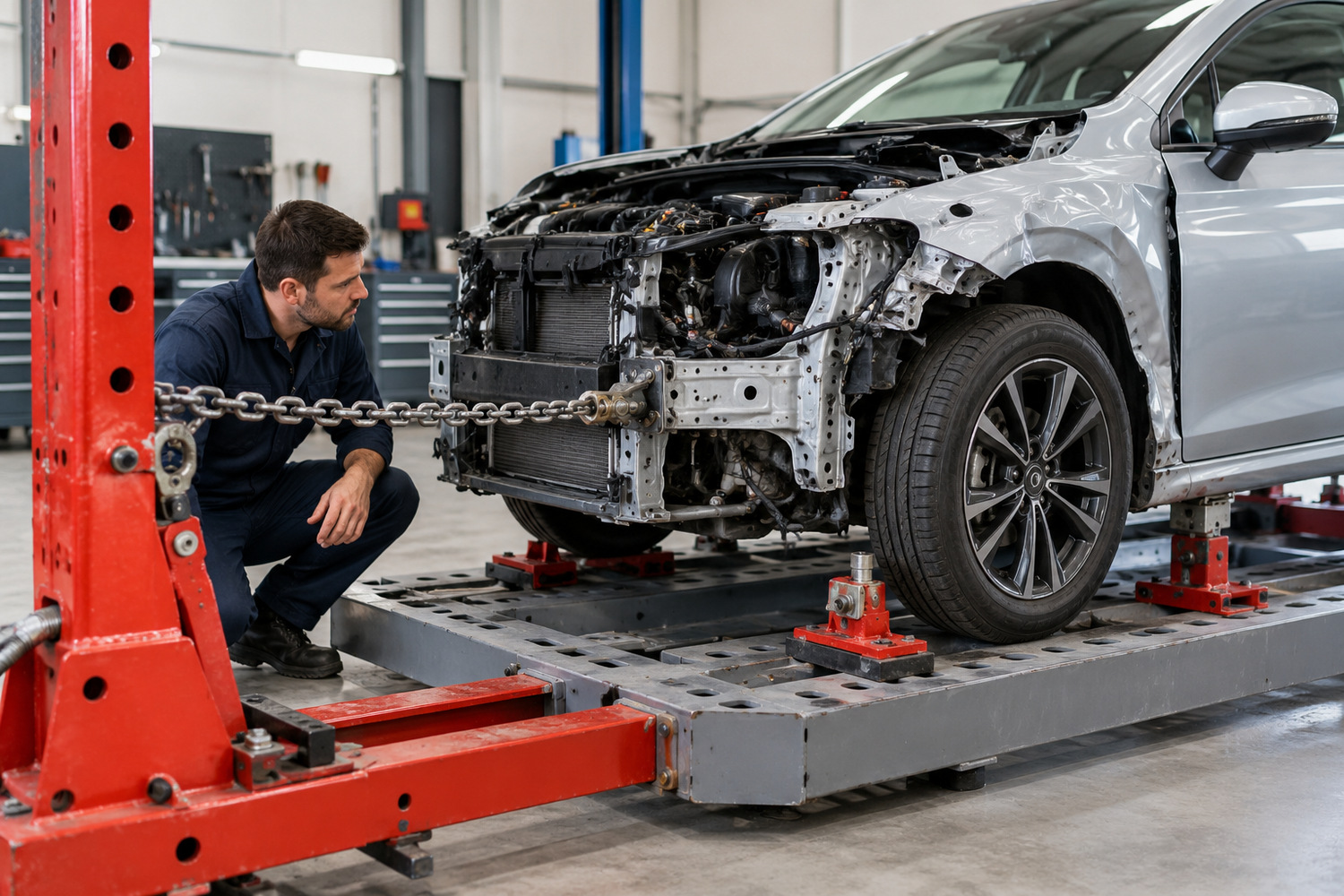
Often, yes. The shell is anchored to the bench and pulled back along the line the impact travelled, under controlled load. Then it is measured again. The second set of numbers is the proof, not the look of the finished car.
What happens to each part of the structure depends on what it is made of and how far it moved.
- Some sections are pulled back into position and stay there.
- Some are cut out and a new section welded in. That is called sectioning. Carmakers set rules about where a cut and a join may go, because the wrong place leaves the car weaker for the next crash.
- Some are not straightened at all. High-strength steels are the harder, thinner steels used to stiffen the cabin. Manufacturer repair procedures limit heating and re-straightening them, and some require a section straightened with heat to be replaced instead.
So the honest answer is sometimes no. Where the repair follows the manufacturer’s specification and a second set of measurements confirms it, the structure is back within the dimensions the car was designed around. That is also the answer to whether a repaired car is safe. Nobody honest will claim more than that.
Sometimes the figures come back far enough out that repairing the car is no longer the sensible spend. At that point it becomes a decision for the insurer rather than a repair question.
Why a crushed front end is not the same as a bent chassis
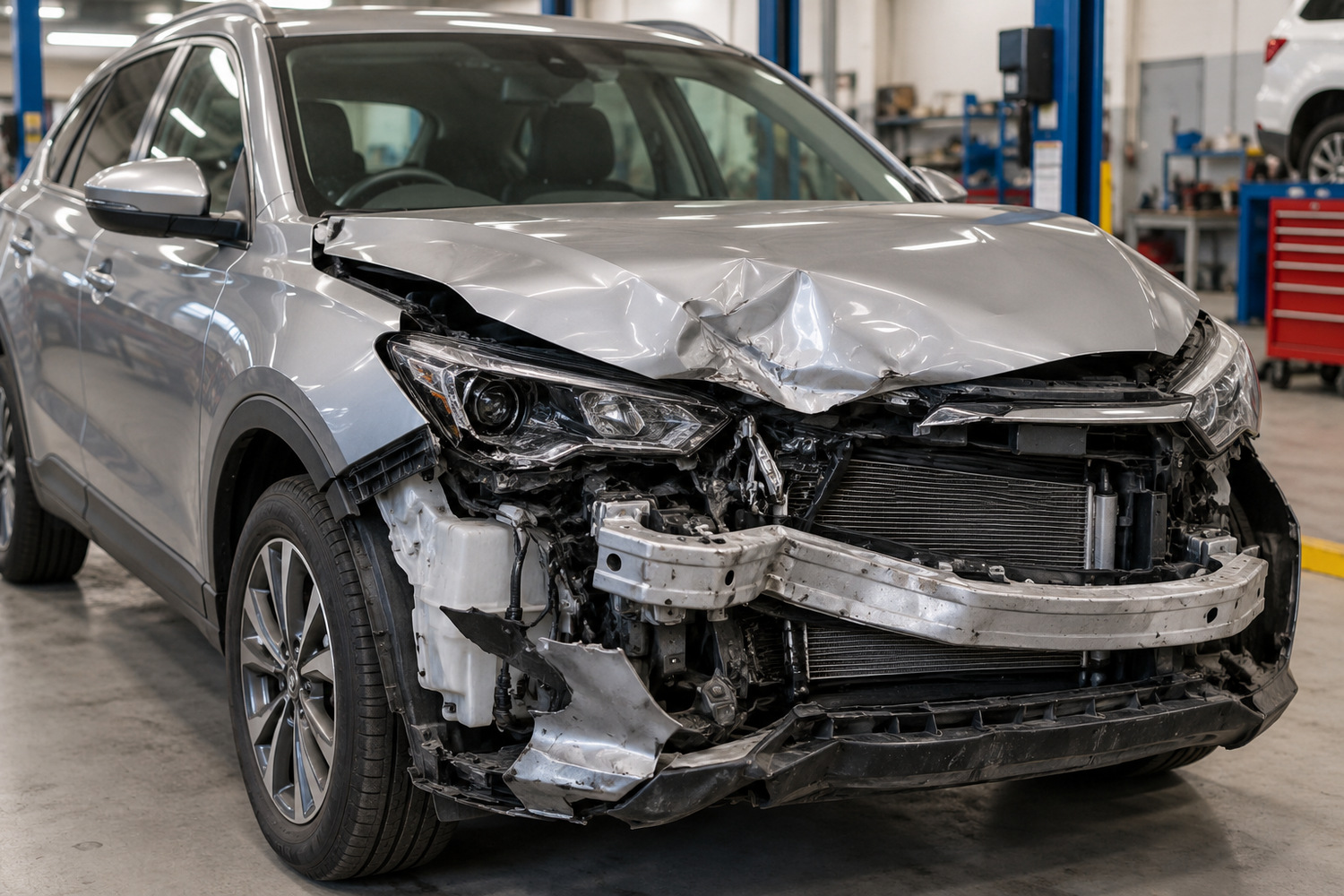
The part of the car that frightens owners most is often the part that worked. The front and rear of a modern car carry crumple zones. These are sections built to fold in a crash and soak up the energy, so less of it reaches the cabin. A front end folded back usually means they did their job.
The question is not how crushed the front is. It is whether what sits behind it moved.
It helps to know what sort of hit reaches that far. A knock in a car park, or a scrape over a driveway lip, almost never gets past the panels. The rear-enders on the Gore Hill Freeway, taken at speed, are where structure starts to move. If the damage turns out to be cosmetic after all, whether your dent can be fixed without repainting is the next question.
Signs a structural repair was not done properly
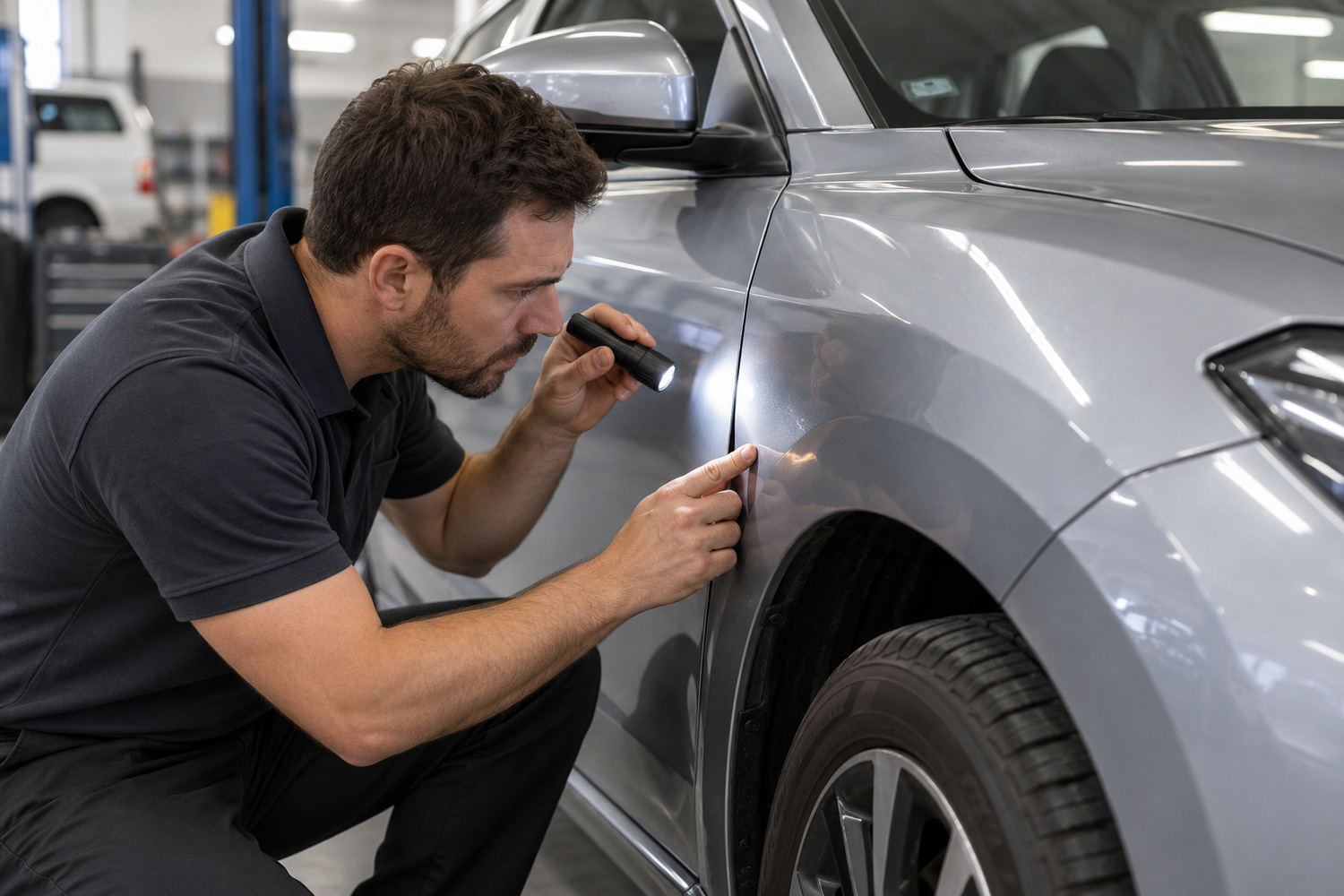
This section is for two readers: one having a repair done now, one buying a used car.
Each of those signs has innocent explanations. A kerbed wheel, worn suspension parts, or an old hinge can each produce one. None of them settles anything alone, which is why the answer is a measurement rather than a hunch.
- Panel gaps wider on one side than the other. Gaps are set by the shell. If they differ across the car, something behind them has moved.
- A door, bonnet or boot that needs a shove. An opening that has lost its shape no longer lines up with its catch.
- A car that tracks slightly crooked. A shell out of square sits the wheels at angles the car was not built with, so it pulls to one side.
- A steering wheel off-centre while the car runs straight. The wheel has ended up square to the road rather than to the car.
- A tyre wearing on one edge, weeks after the repair. Wheel angles a little out scrub rubber off one shoulder.
Frequently asked questions
What is chassis straightening?
It is the controlled pulling of a car’s structure back towards its published dimensions, with the car anchored to a bench. Measurements are taken before and after. They are what show the work is finished.
Is chassis damage permanent?
Usually not. Where the metal allows it, the structure can be brought back to its measured position and checked against the carmaker’s figures. Where it does not, that section is replaced instead.
How can you tell if a used car has had structural repairs?
Look along the panel gaps, open and close every door and the boot, then drive it on a straight road. None of that is proof. A car you are serious about is worth having measured.
Have the car measured, not judged from photographs
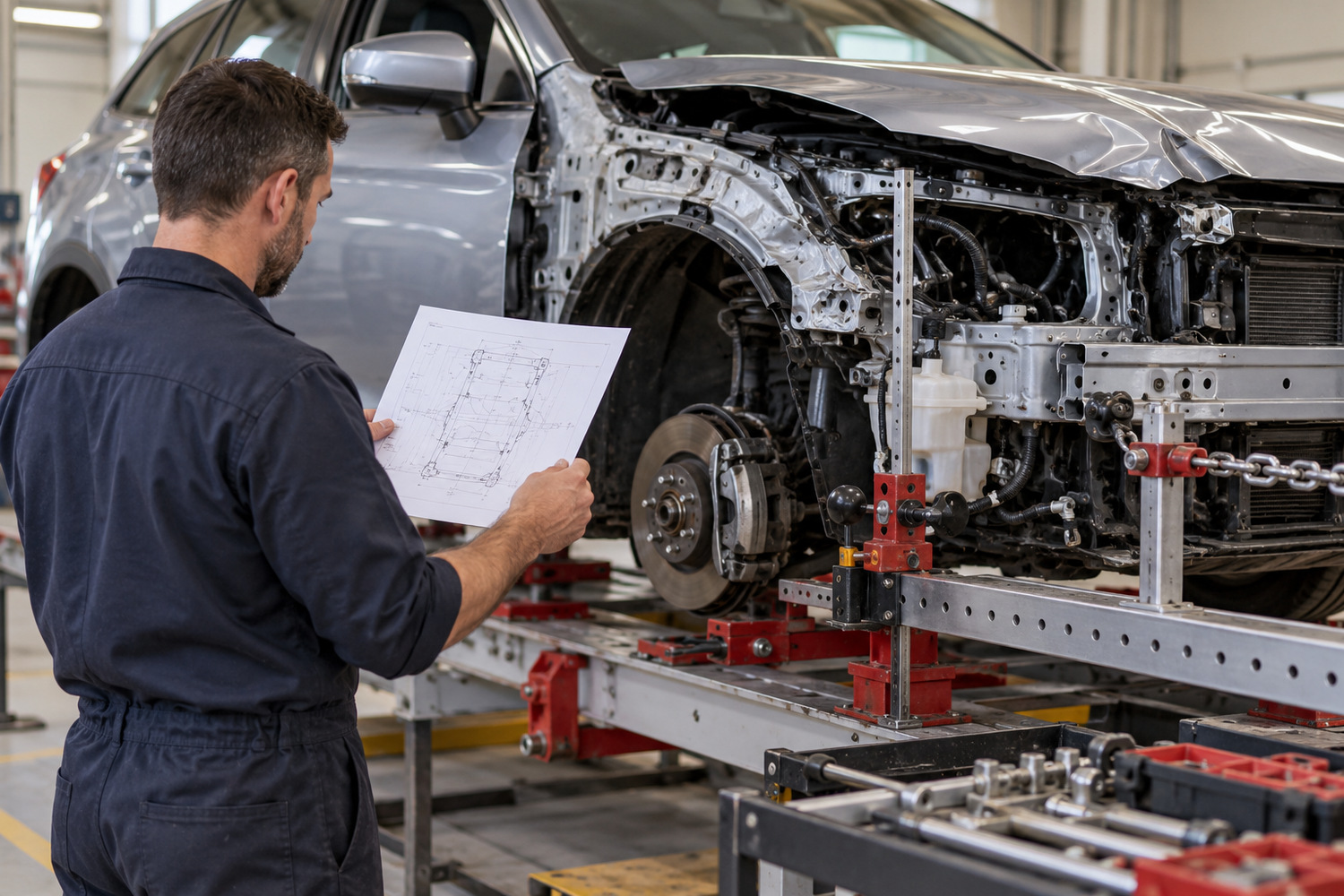
Photographs are enough for a scratched bumper. They cannot show whether a shell has moved. That movement sits at mounting points underneath, and it is reported as a difference in millimetres.
If your car has taken a solid hit, have it put on a bench and measured. North Shore Smash Repairs does chassis repair and panel work in Artarmon. An assessment answers the question for your car. The figures either show the structure sitting where it should, or show what moved. You can book an assessment online, or drive it in and have the measurements taken first.


