

After a scrape or a panel repair, the worry is nearly always the same. Will you be able to see where the new paint stops and the old paint starts? In most cases, no. A good car spray painter can match a repair so closely that you cannot pick the join, even in direct sun.
It is the biggest question people have about car spray painting, and the honest answer is reassuring. The trick is that matching is not just reading your car's paint code and mixing that colour. It is reading the colour your car wears today, then blending the fresh paint into the panels around the repair so there is no hard line. That is the short answer. Here is what sits behind it, and what to ask for so you get a match you are happy with.

How do spray painters match your car's colour?
Every factory colour has a paint code. It is a short set of letters and numbers, usually on a sticker in the driver's door opening, under the bonnet, or in the boot. That code is the starting point, not the finish line.
The code tells the painter which base formula your colour came from. Many carmakers also release a few slightly different versions of the same code, called variants, to allow for factory batch differences. Picking the right variant is part of the job.
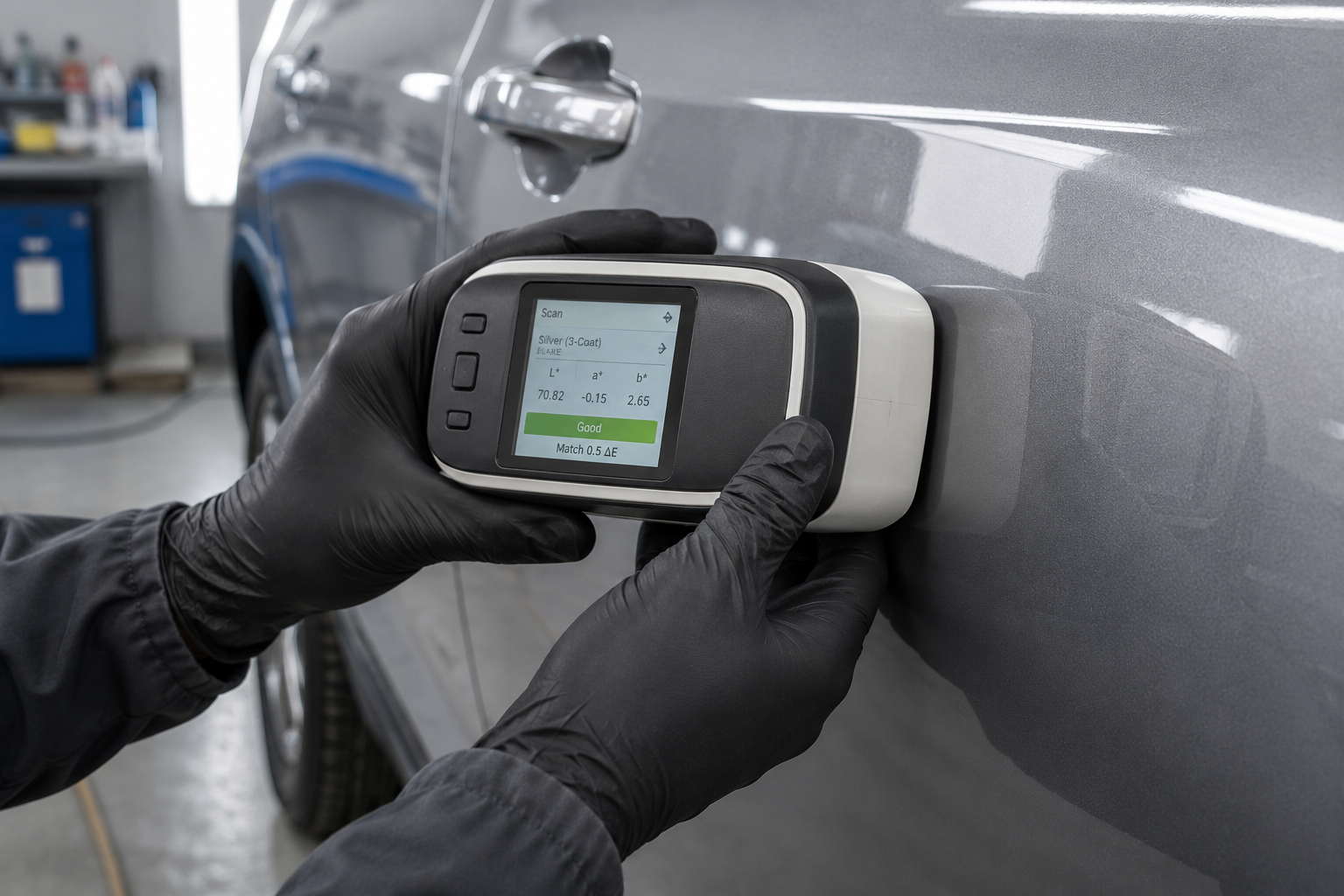
What the code cannot tell the painter is how that exact paint has aged on your car. Two cars off the same production line can wear differently after a few years outside. So a good shop reads the real colour on your panels, often with a colour-matching camera called a spectrophotometer (a tool that measures the exact shade, tone and brightness of your paint). Then they fine-tune the mix by adding small amounts of tint until it lines up.
Before any paint goes near your car, the painter sprays the mixed colour onto a test card or spare panel and holds it against your paintwork. This is called a spray-out. If it is not right, they adjust and try again. The car only gets painted once the match is confirmed.
| What the paint code gives the painter | What it can't account for |
|---|---|
| The base colour formula from the factory | How your paint has faded in the sun |
| A known starting mix to work from | Batch-to-batch variation between cars |
| The right paint type for your vehicle | Wear, oxidation and age on your panels |
Why painters blend into the next panel
Even a perfect mix can show a faint edge if a single panel is painted right up to its border. Light hits a fresh, flat panel a little differently to the panels beside it. So instead of stopping the new paint at the panel edge, the painter feathers it out into the next panel. This is called blending.
Blending spreads any tiny difference across a wider area, so your eye never catches a line. It is the reason a repaired guard sits so naturally next to the door and bonnet around it. It is normal, skilled work, not a sign that something went wrong.
Are metallic and pearl colours harder to match?
Yes, and it is worth knowing why. A solid colour is one flat coat. A metallic or pearl colour has tiny flakes in it that catch the light. The way those flakes sit, how many coats go on, and the angle you view the panel from all change how the colour looks. That is why a metallic silver or a deep pearl white can look like a slightly different shade as you walk around the car.
Matching these finishes takes more coats and more care with the spray technique. A good shop will still get there, but it is a bigger job than matching a plain white or black. If you drive a BMW, Audi, Mercedes or Porsche with a factory metallic or pearl, this is the sort of work that sets a proper refinish shop apart from a quick paint job.
What if my car's paint is old or faded?
Age is the hardest part of colour matching, not the colour itself. Every car's paint slowly fades under the sun. On the North Shore, cars that live outside near the coast cop strong sun and salt air, and the paint dulls a little each year.
A brand-new mix that matches the factory code will often look too fresh next to faded paint. So the painter matches to the faded colour on your car, not the colour it was when new. On an older or badly faded car, they may blend across more panels to keep everything even. It is worth asking how many panels a repair will touch, so there are no surprises.
Special-order and discontinued prestige colours
Some prestige and late-model cars come in special-order or limited paint colours. These can take longer to source and cost more to mix, because the formula may not be a standard stock colour. Discontinued colours on older cars can be harder again, as the exact factory paint may no longer be made.
None of this stops a good shop matching the colour. It just means the quote and the timeline can be different to a standard colour. If cost is your main question, there is a separate guide on what drives the price of a respray and how to read your quote.
What to ask for in your respray quote
A few simple questions tell you whether a shop takes colour matching seriously:
- Will you read the colour off the car, not just the paint code?
- Will you do a spray-out to confirm the match before painting?
- Will you blend into the next panel to hide any edge?
- How many panels will the repair touch?
- Is my colour a standard, metallic, pearl or special-order finish?
A shop that answers these clearly is one that will get the match right.
Get your paintwork looked at
If you have a fresh scrape, a resprayed panel that no longer matches, or a repair coming up on a prestige car, the best next step is a paintwork inspection. Send a few photos of the damage, or book the car in, and ask for a colour-match and blending explanation as part of your quote.




